TRIBUTO. Shapewear e-commerce, engineered to convert.
Feb 2022 - Jun 2025 · fajastributo.com · CTO
Tributo is a US shapewear brand selling highly customized post-surgery garments. I came in as a strategic consultant, became CTO, and rebuilt the storefront. It ran on a Shopify Plus template doing millions in sales but scoring 29 out of 100 on speed. I replaced it with a headless store rebuilt as static pages on island architecture.
A shapewear buyer is usually recovering from surgery, and recovery runs in stages. A few questions (which surgery, and when) place each customer in a stage, and the store reorders itself around her: stage-appropriate products, her name, a timed discount. On one Black Friday the control group converted at 8 percent; the personalized cohort converted at 32.
INSIGHT
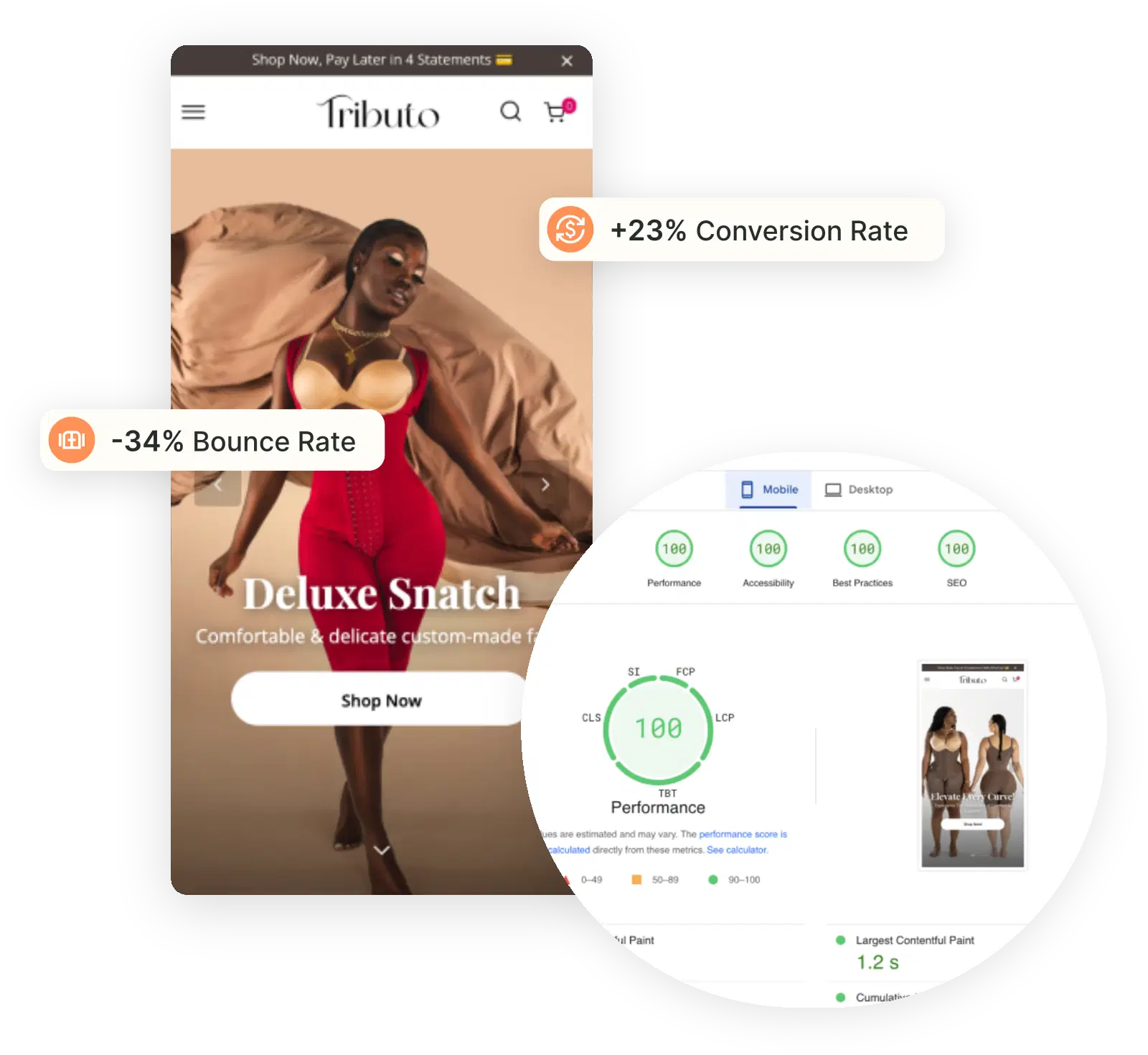
Speed is not a vanity metric in e-commerce; it is conversion. A store built from a template and thirty plugins cannot be fast, and a slow store leaks buyers at every step. Rebuilding it as static pages that regenerate every hour made it fast and dynamic at once. Speed plus personalization is what turned browsers into buyers, and the conversion rate roughly doubled.
WHAT I BUILT
- Headless Astro storefront
- Hourly static regeneration pipeline
- Custom variant and customization app
- Add-on and upsell support
- Backend layer over Shopify API
- Surgery-stage personalization engine
- Mixpanel attribution
- Campaign landing pages
- A/B testing program
- Python statistical analysis
[Images / demo clip go here]
HOW IT'S BUILT
- Astro frontend on island architecture
- Whole catalog rebuilt to static pages hourly via CI
- Manual rebuild button inside the Shopify admin
- Shopify Plus kept as the backend
- Up to 100 variants per product, unsupported in a headless setup
- Variant data stored in a custom product field the frontend reads
- Add-ons modeled as separate products, hacked to belong to their parent
- Mixpanel for multi-touch attribution
DECISIONS
Went headless instead of optimizing the template. The store ran on Shopify Plus with a template and thirty-plus plugins, plus a plugin that hacked in product customization unreliably while the others fought it. No amount of tuning fixes that. We moved to the Shopify API as a backend and built our own frontend. The cost was real: variants and add-ons no longer came out of the box, so we wrote months of custom software to replace them.
Chose Astro islands and rebuilt the store hourly. We weighed Hydrogen (too young then), Vue, React, and Next, and avoided anything that meant learning a new language when the goal was conversion, not a rewrite. Island architecture gave us rendered pages that are extremely fast and still dynamic. The cost is freshness: the catalog rebuilds every hour through CI rather than instantly, so we added a button in the Shopify admin to rebuild on demand, and someone maintains a pipeline with no off-the-shelf equivalent.
Kept Shopify for the backend and checkout, rebuilt only the frontend. We could have built a backend from scratch, but the scope was huge, Shopify is reliable, and the client already ran their business from its back office with years of custom shipping and plugin work. Checkout especially is where compliance and security are hardest and least worth reinventing, so we forwarded users there. The cost: we are bound to Shopify's model and had to rebuild most frontend-touching plugins ourselves.
Personalized on the surgery-recovery decision tree. A garment like this is bought around surgery, and recovery runs in stages. A few questions place the customer in a stage, and the store reorders products and promotions to match, greets her by name, and adds a timed discount. It cost an upfront question flow (friction) and the engineering to segment and serve by stage. On Black Friday it paid: 8 percent control, 32 percent personalized.
OUTCOMES
- General conversion rate roughly doubled: about 2 percent to about 5 percent
- Black Friday personalization: 8 percent control versus 32 percent personalized
- 100 out of 100 mobile PageSpeed, up from about 29
- More than a year after handoff, still running the same custom software
LEARNINGS
- Owning the build beats renting a template when you have control and time: the result was faster, lasting, and genuinely optimizable.
- With non-technical clients, communication moves the relationship as much as the code. Work they cannot see reads as untrustworthy no matter how good it is.
- Island architecture is a real lever on both SEO and speed. It is now my default for public sites.
STATUS
The engagement ran February 2022 to June 2025. The store I built is still in use and has sold in the millions to date.